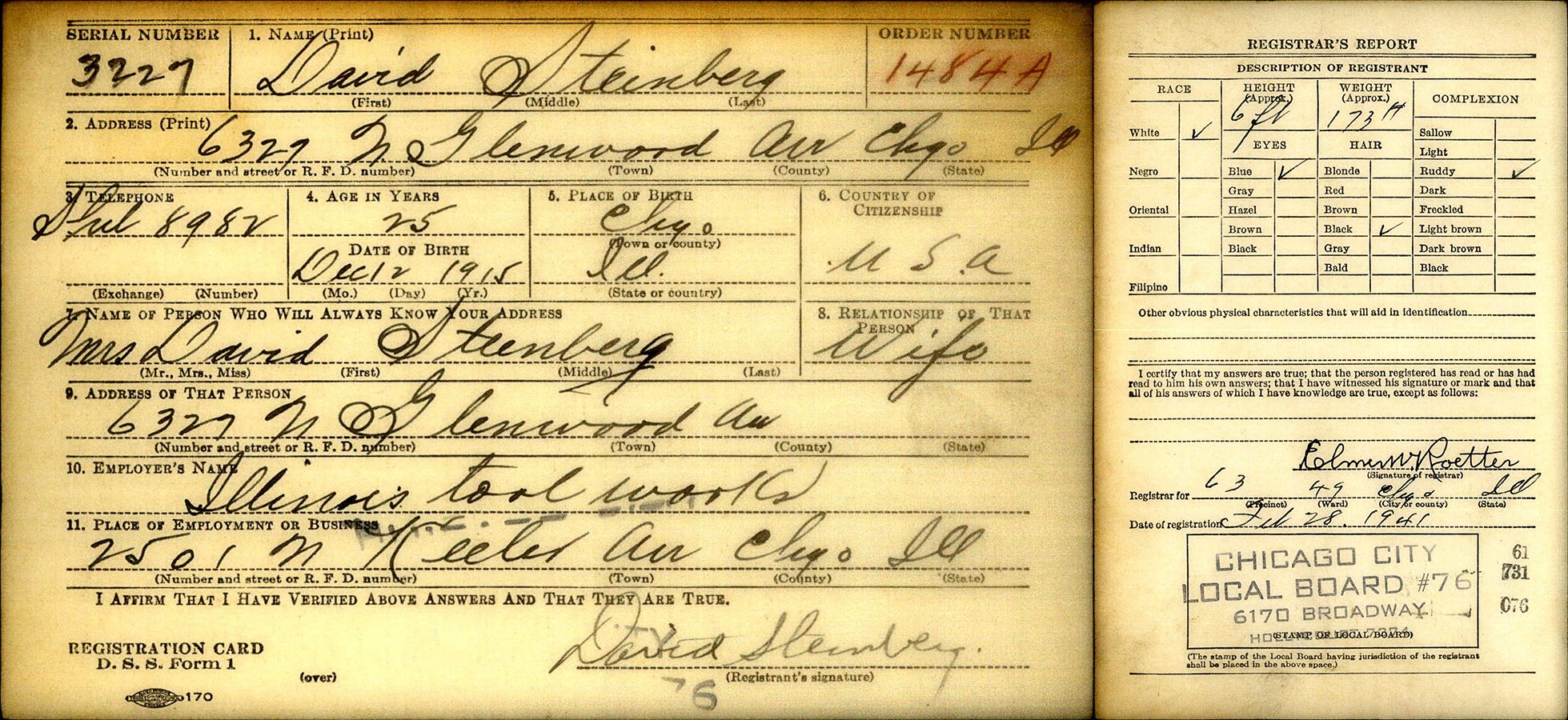
David Steinberg
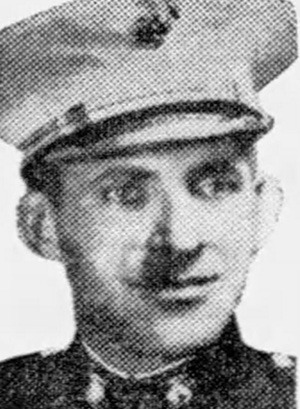
First Lieutenant David Steinberg served as an aerial observer with H&S Battery, Fourth Battalion, 13th Marines.
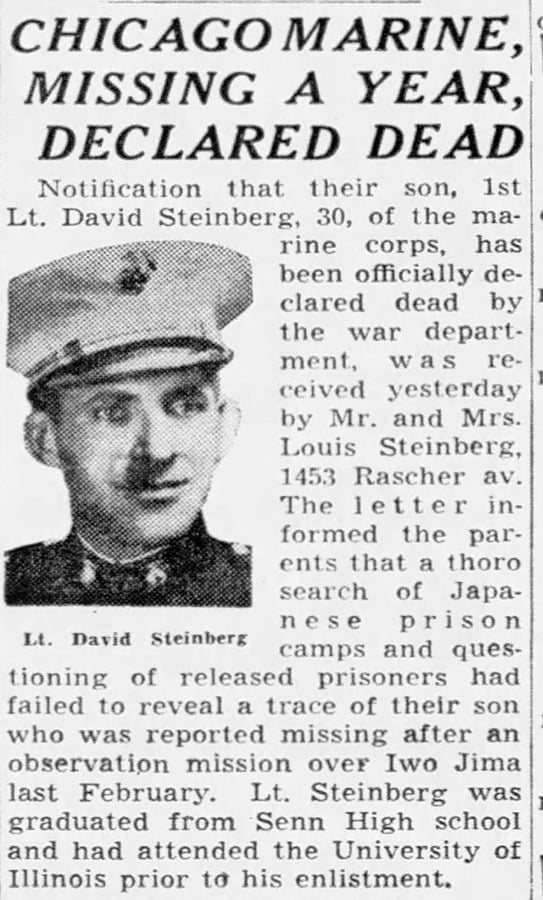
He was reported missing in action in the loss of USS Bismarck Sea during the Iwo Jima campaign, 21 February 1945.
Branch
Marine Corps Reserve
Service Number O-27066
Current Status
Remains not recovered
Pursuit Category
Based on circumstances of loss, this individual is considered permanently non-recoverable.
Capsule History
Pre-War Life
Birth
December 12, 1915
in Chicago, IL
Parents
Louis Steinberg
Ethel (Blumberg) Steinberg
Education
Senn High School
University of Illinois
Occupation & Employer
“Chemical apparatus operator”
Illinois Tool Works
Service Life
Entered Service
January 30, 1943 (enlisted)
July 14, 1943 (commissioned)
Home Of Record
1453 Rasher Ave
Chicago, IL
Next Of Kin
Parents, Louis & Ethel Steinberg
Military Specialty
Intelligence Officer (Bn-2)
Aerial observer, artillery
Individual Decorations
Purple Heart (Iwo Jima)
Loss And Burial
Circumstances Of Loss
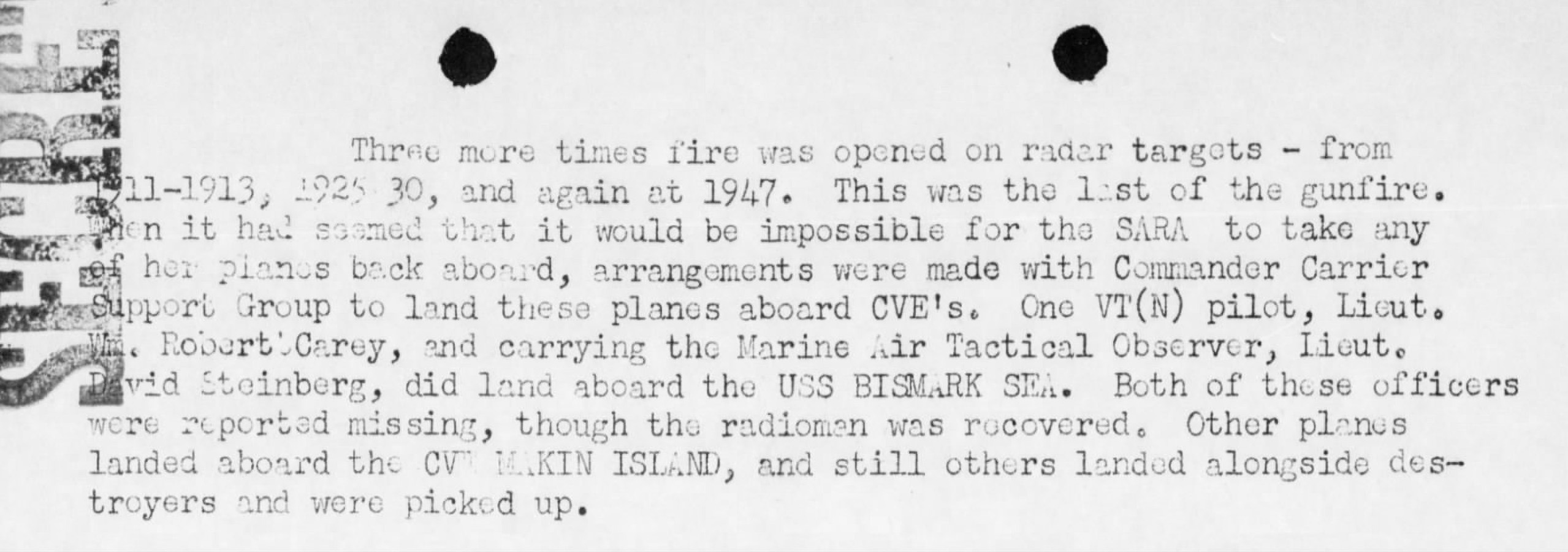
David Steinberg served as an aerial observer with the 13th Marines, the artillery regiment of the Fifth Marine Division. In January 1945, he was detached from his battalion and sent to the carrier USS Saratoga for duty during the invasion of Iwo Jima. Saratoga‘s squadrons specialized in night missions, and Steinberg flew with VT(N)-53 – a newly commissioned bomber squadron trained for such operations. On 19 February 1945 – D-Day at Iwo – Sara’s history proudly notes that “at 1858… a VT(N) was launched carrying a Marine Air Tactical Observer to Iwo Jima. This was the first time that night gunnery and troop movement observers had been used in amphibious operations at night.” Some teething problems occurred, but all hands seemed confident in this new aspect of warfare.
As Saratoga prepared to launch her first strike on the afternoon of 21 February, worrying reports of incoming hostile aircraft reached the bridge. The carrier went to General Quarters and started clearing the flight deck, launching as many aircraft as she could. One VT(N)-53 bomber managed to take off – this was probably Steinberg’s plane, with Lt(j.g.) William R. Carey and an unnamed enlisted radioman aboard. Less than ten minutes later, an intense kamikaze attack descended on Sara, blasting holes in the flight deck and starting major fires. The carrier was unable to recover any of her planes, and sent out a call to the task force to allow her pilots to land wherever possible. The USS Bismarck Sea (CVE-95) reported “taking aboard…. one SARATOGA TBM which was looking for a place to land.”
Carey brought the TBM down to the deck, and the three aviators must have thanked their lucky stars to have escaped the conflagration on Saratoga. Unfortunately, their luck quickly ran out. Another wave of bombers approached, and two slammed into the Bismarck Sea. Aviation fuel and munitions exploded, and within fifteen minutes the order was given to abandon ship. Bismarck Sea sank that evening, taking 318 of her crew to their deaths.
Two more might be added to that number. 1Lt. David Steinberg and Lt(j.g.) William Carey were lost in the sinking, their remains never to be recovered.
(The radioman, fortunately, was rescued and survived.)
Burial Information or Disposition
Lieutenant Steinberg’s remains were lost at sea. In keeping with Navy tradition, the wreck of the Bismarck Sea is considered his final resting place.
Memorials
Next Of Kin Address
Address of parents, Louis & Ethel Steinberg
Location Of Loss
The Bismarck Sea sank at this approximate location, 44 miles from Iwo Jima