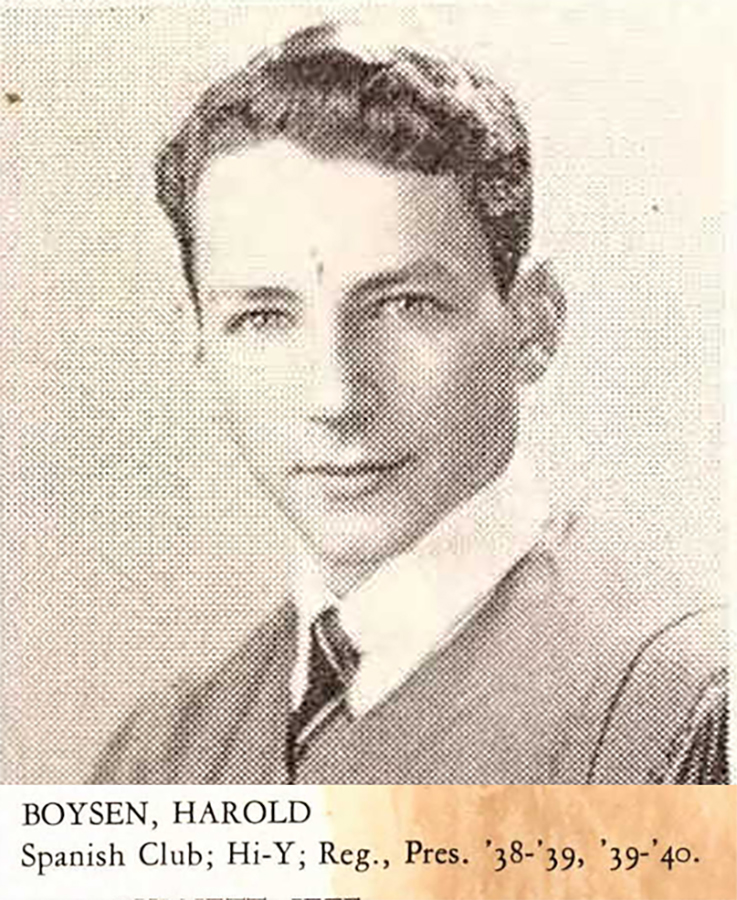
Harold Edwin Boysen
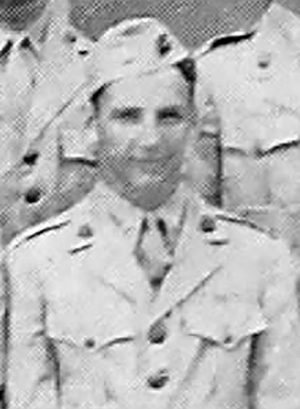
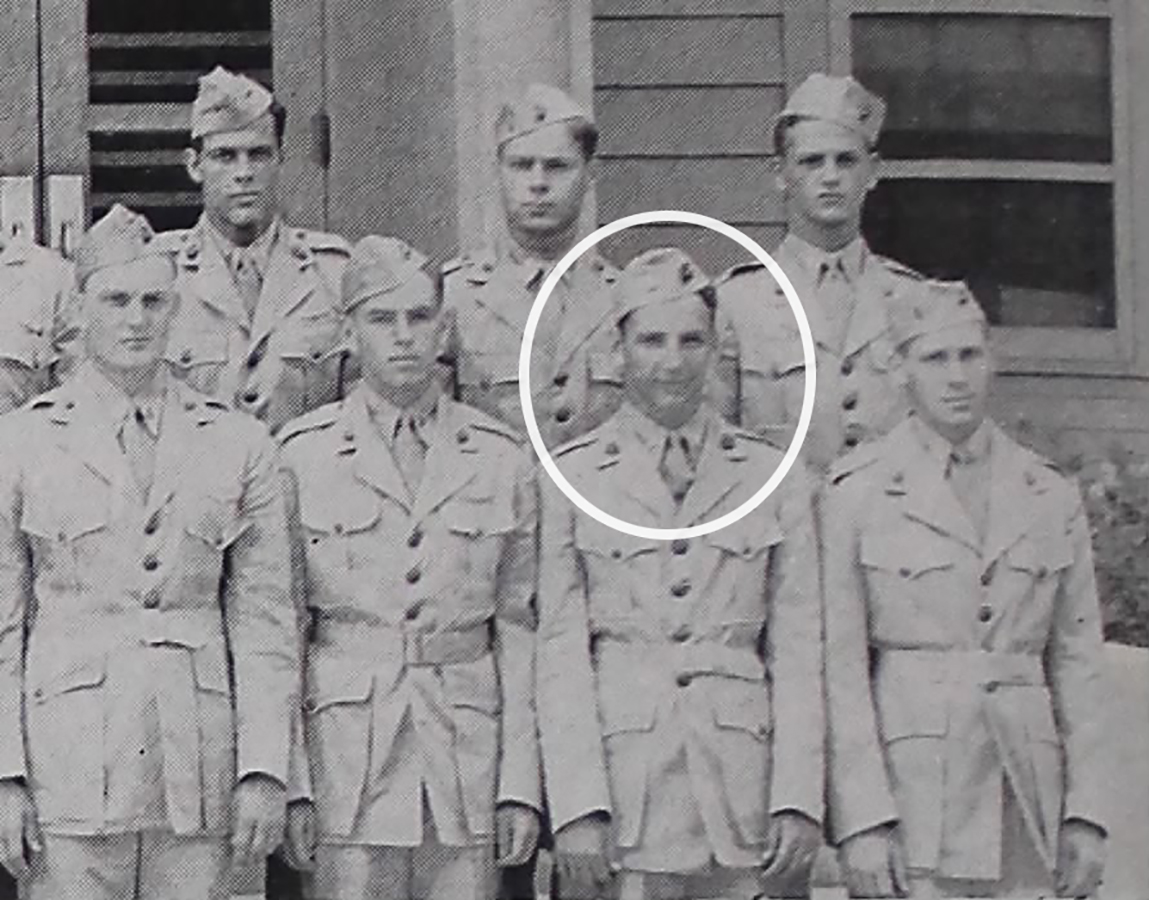
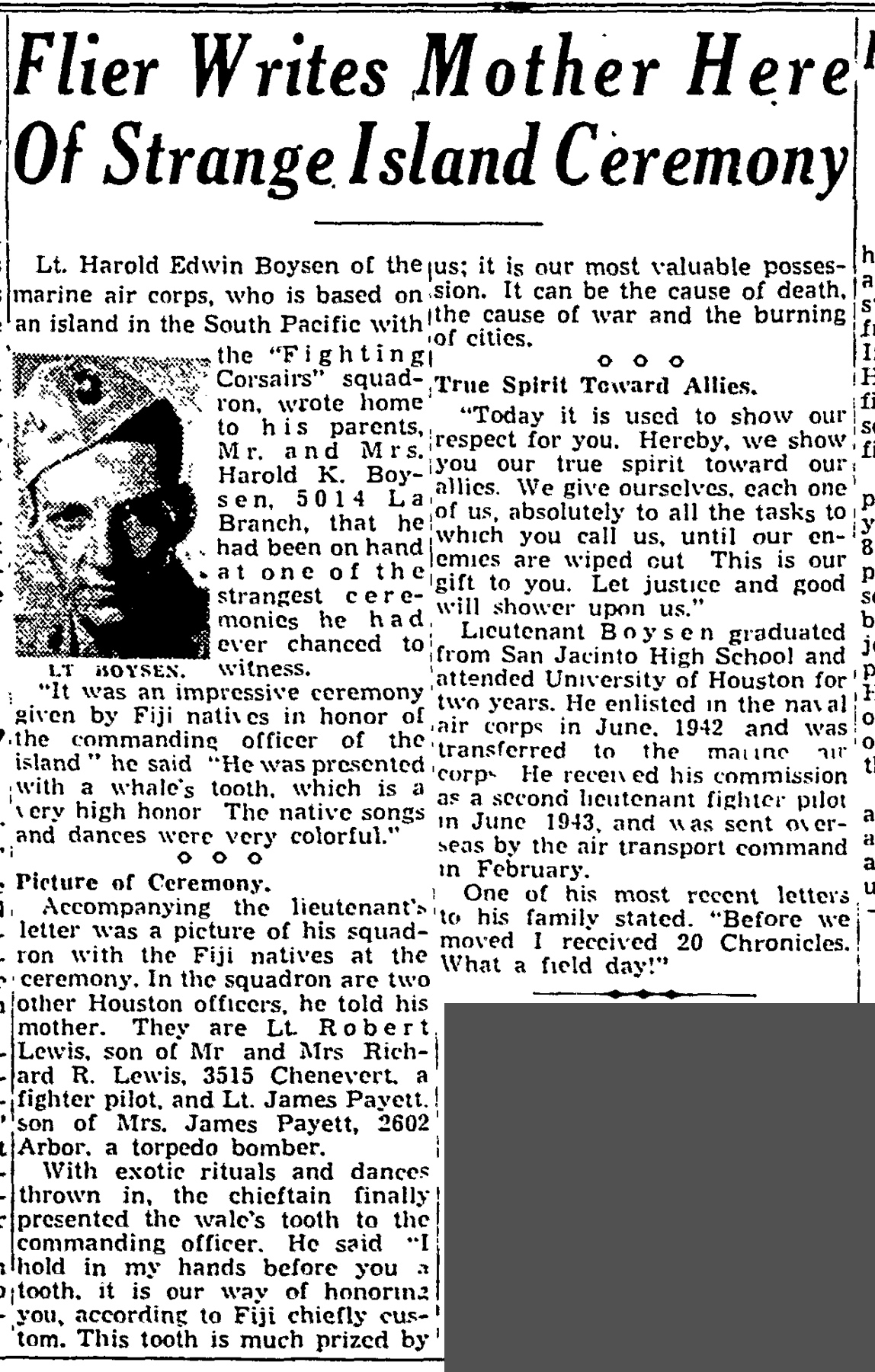
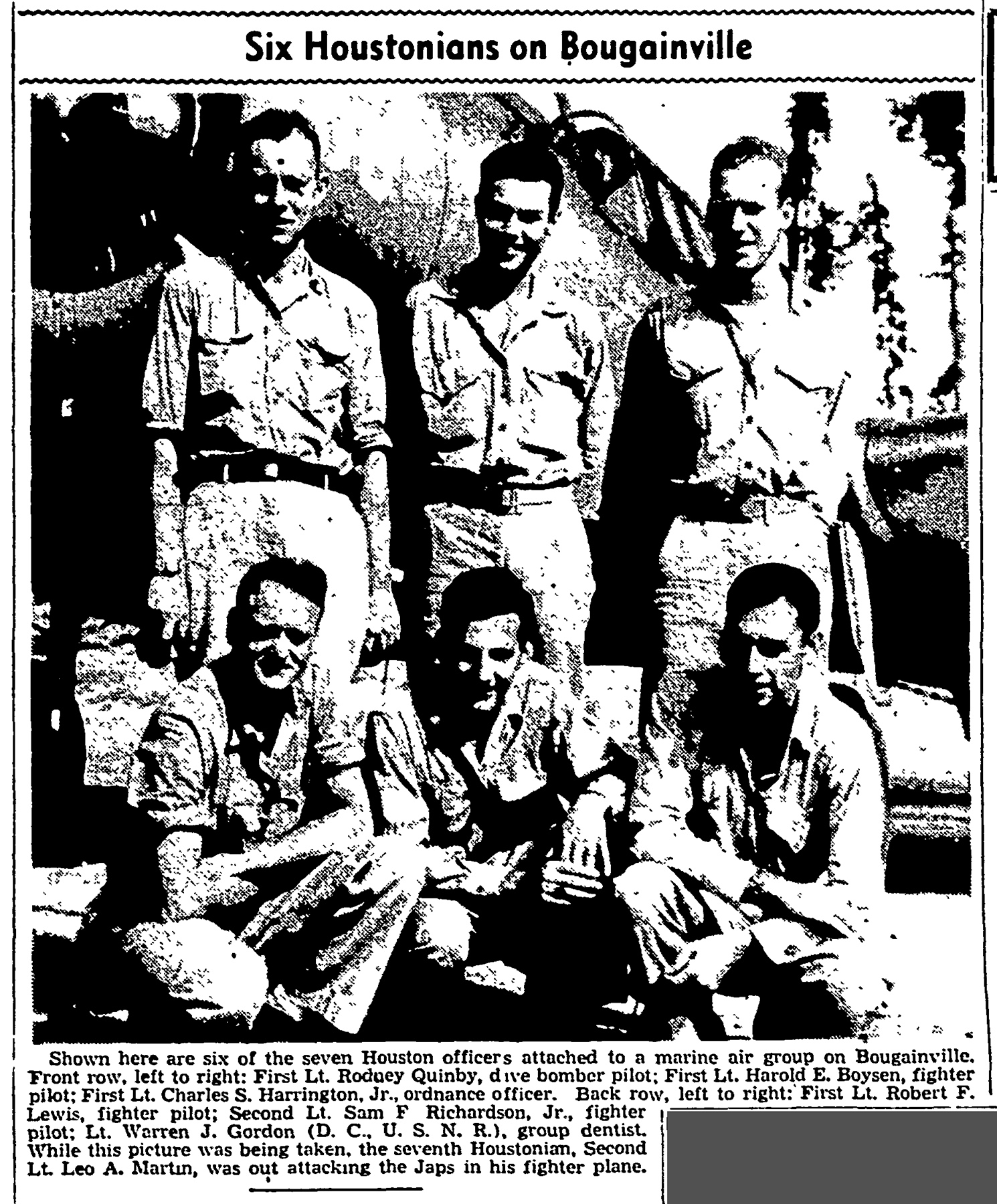
First Lieutenant Harold E. Boysen was a Marine fighter pilot who flew with VMF-212.
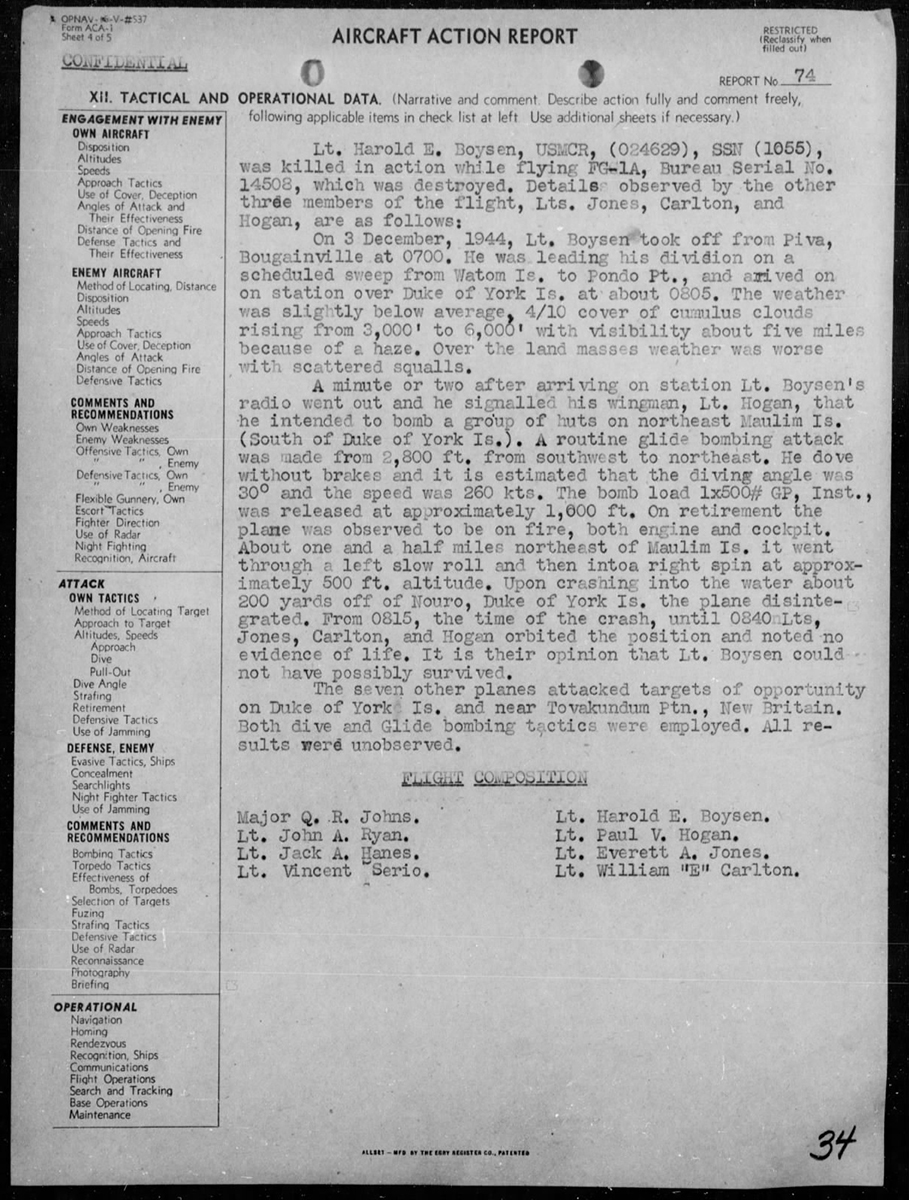
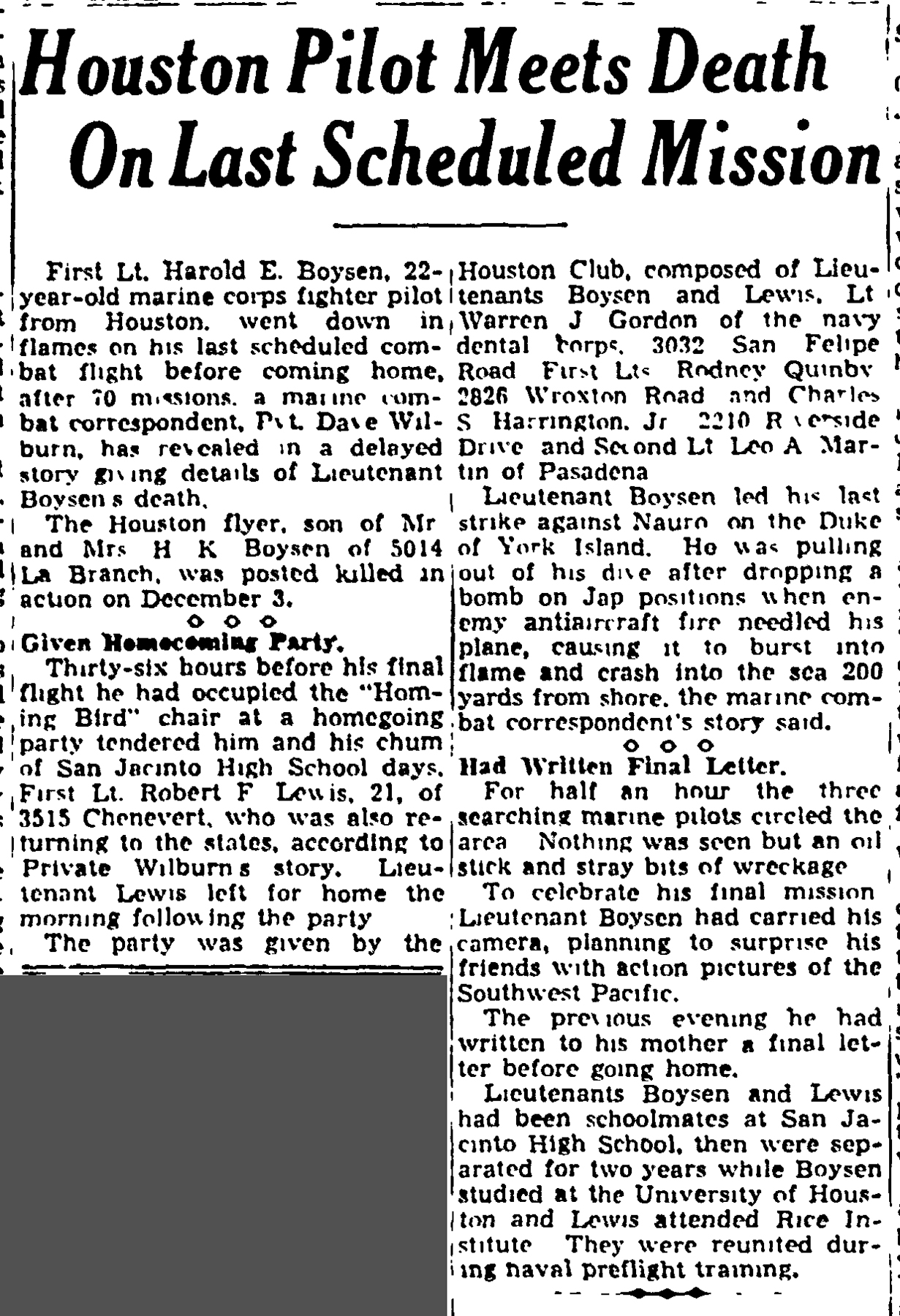
He was lost on a combat mission in the Duke of York Islands on 3 December 1944.
Branch
Marine Corps Reserve (Aviation)
Service Number O-24629
Current Status
This individual has been recovered or is not recovered.
Pursuit Category
The DPAA has not publicized this information.
Capsule History
Pre-War Life
Birth
July 10, 1922
at Navasota, TX
Parents
Harold Koch Boysen
Lorena (Ferguson) Boysen
Education
San Jacinto High School (1940)
University of Houston (ex-1944)
Occupation & Employer
Humble Oil & Refining Company
Service Life
Entered Service
June 12, 1943 (commission)
at Corpus Christi, TX
Home Of Record
5014 La Branch
Houston, TX
Next Of Kin
Parents, Harold & Lorena Boysen
Military Specialty
Fighter Pilot
Primary Unit
VMF-212
Campaigns Served
Two tours with VMF-215 (April-August 1944)
One tour with VMF-212 (September-December 1944)
Individual Decorations
Distinguished Flying Cross
Purple Heart
Additional Service Details
—
Loss And Burial
Circumstances Of Loss
First Lieutenant Harold Boysen, an experienced Marine Corps fighter pilot, flew F4U and FG-1 Corsair planes with VMF-215 and VMF-212 during the campaigns for the northern Solomon Islands and the Bismarck Archipelago. By early December 1944, Boysen had nearly seventy missions under his belt and was anticipating a rotation back to the United States. He was even treated to a party hosted by his high school buddy 1Lt. Robert F. Lewis, who was also headed home after a long spell in combat.
On 3 December 1944, Boysen climbed into the cockpit of an FG-1 Corsair (Bureau Number 14508) and prepared for one last fighter sweep of the Gazelle Peninsula. He led his division of three other pilots from Piva North Airfield to Watom Island, and set a course for Pondo Point. Boysen was well familiar with the route, and brought along a camera to snap some farewell action photos. He was probably disgusted at the hazy cloud cover which reduced visibility to a mere five miles.
At 0805, Boysen’s division arrived over the Duke of York Islands. As if on cue, his radio went out. Lieutenant Paul V. Hogan saw Boysen signalling an intent to attack a cluster of huts on Mualim Island. The flight leader nosed down into a glide and accelerated towards his target before releasing his 500-lb bomb at 1600 feet.
Immediately, #14508 began spewing smoke. Hogan saw flames in the engine and cockpit. The Corsair flew normally for about a mile and a half, started a slow roll to the left, and then spun to the right, completely out of control. It struck the water about 200 yards from Nouro Village and “disintegrated.” Lieutenants Hogan, Jones, and Carlton circled the site for thirty minutes, but could see no trace of Harold Boysen. “It is their opinion that Lt. Boysen could not have possibly survived,” noted the squadron’s After Action Report.
Lieutenant Harold Boysen died on what should have been his final mission. He was also the last combat fatality of VMF-212’s six-month tour. Five days later, the flight echelon received orders to stand down and pause combat operations.
The cause of Boysen’s crash was not officially determined. However, two other planes returned from the mission with damage caused by their own bombs, and the squadron AAR reported this as “probable cause” for the demise of #14508.
Burial Information or Disposition
None recorded; plane crashed at sea.
Memorials
Next Of Kin Address
Address of parents, Harold & Lorena Boysen.
Location Of Loss
Approximate location of the crash, 1.5 miles Northeast of Mualim Island, 200 yards offshore.