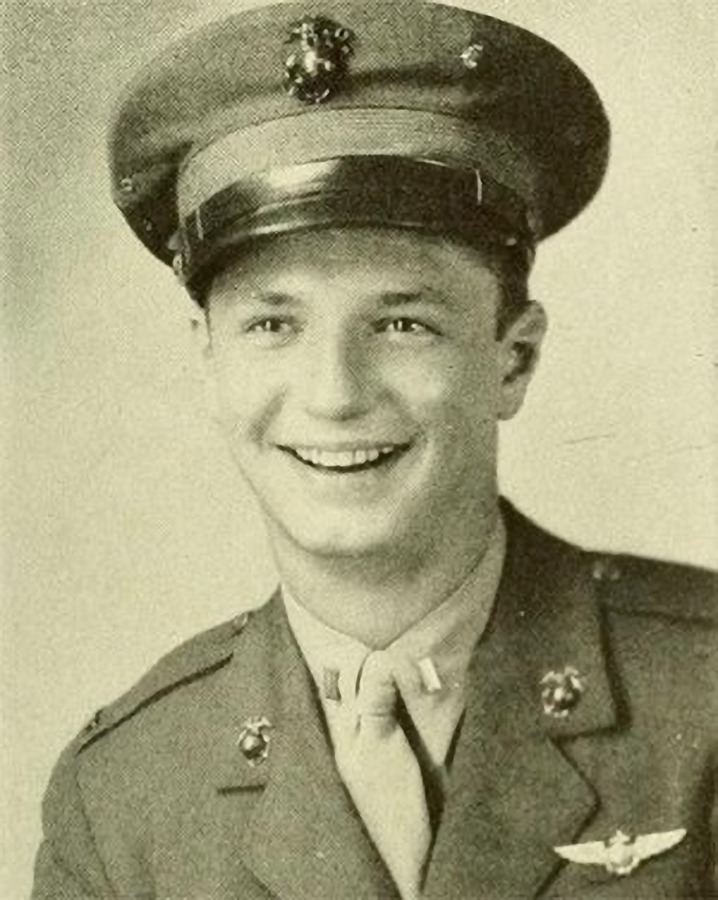
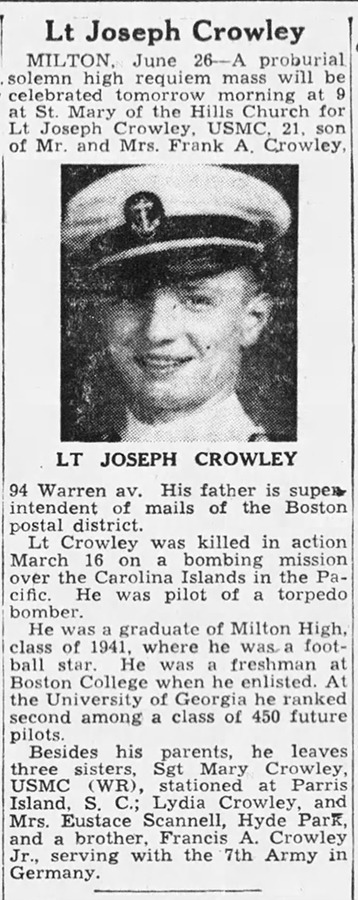
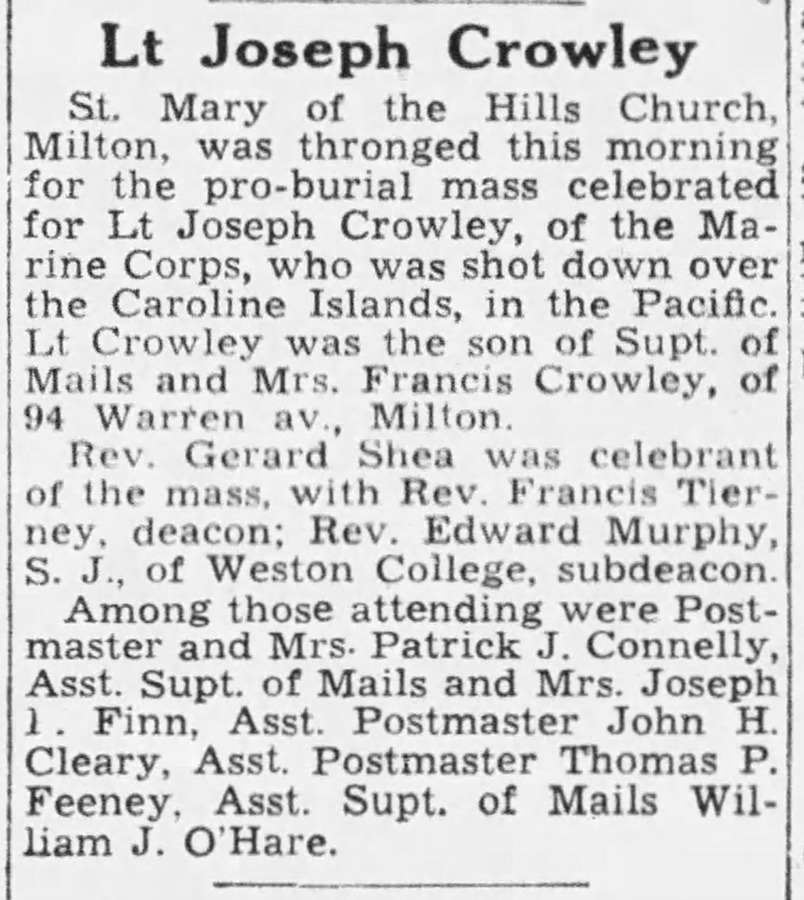
Joseph Crowley

First Lieutenant Joseph Crowley was a Marine Corps bomber pilot flying with VMTB-232.
He was killed in action at Yap on 16 March 1945.
Branch
Marine Corps Reserve
Service Number O-31322
Current Status
Remains Not Recovered
Pursuit Category
The DPAA has not publicized this information
Capsule History
Pre-War Life
Birth
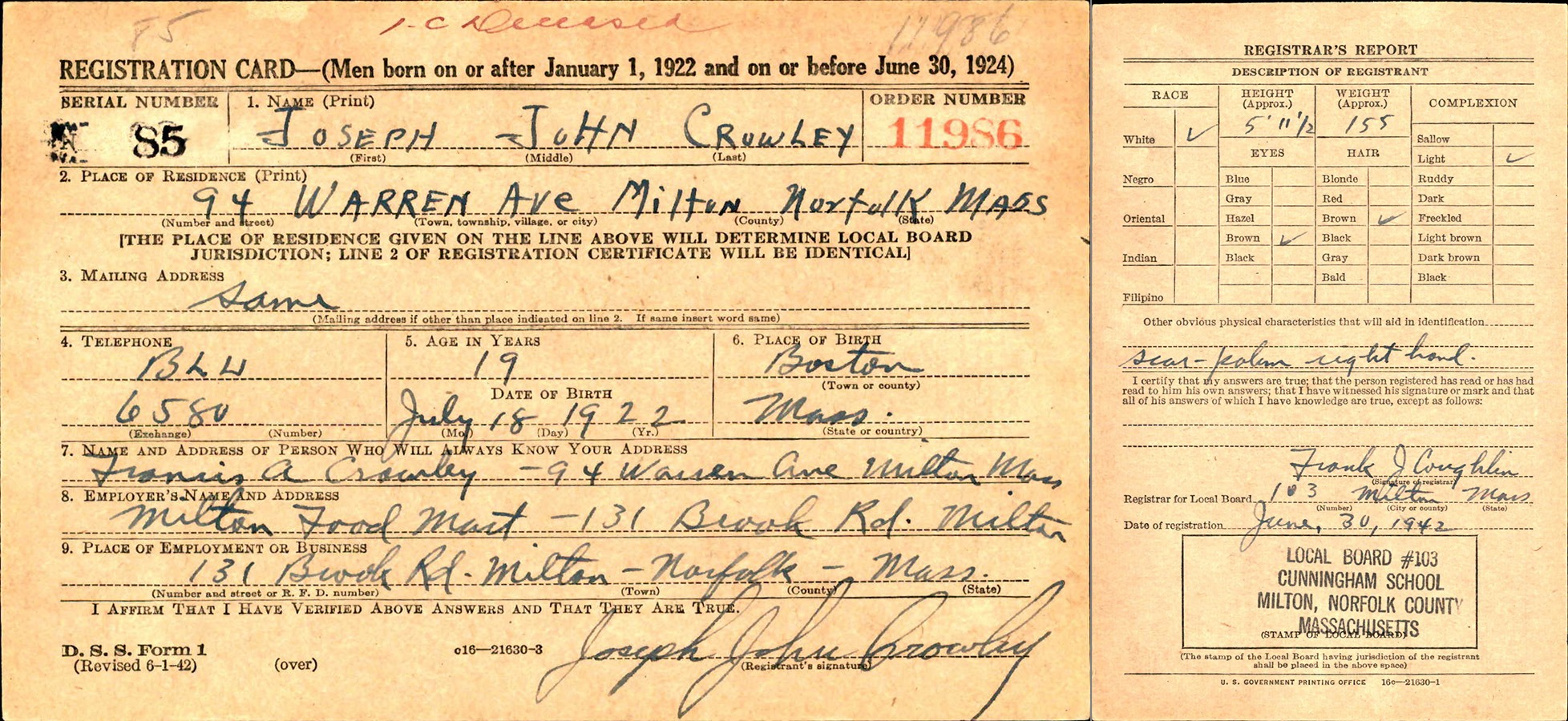
June 18, 1923
in Boston, MA
Parents
Francis A. “Frank” Crowley
Lydia F. (Clarke) Crowley
Education
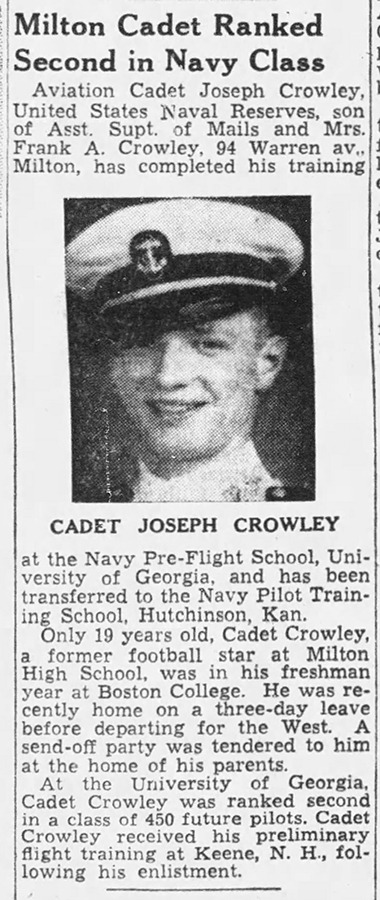
Milton High School (1941)
Boston College (ex-1945)
Occupation & Employer
College student
Service Life
Entered Service
August 7, 1942 (enlisted)
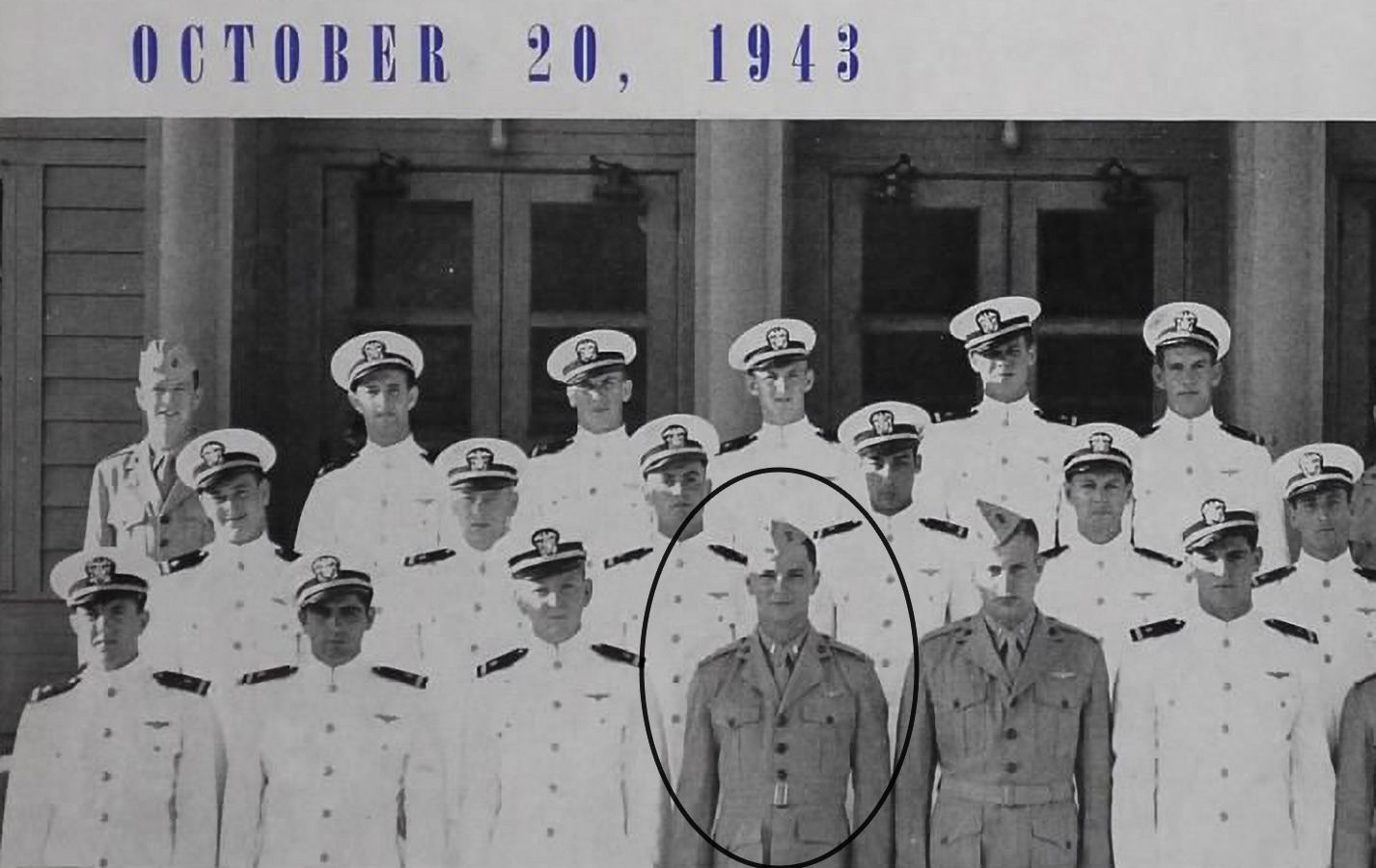
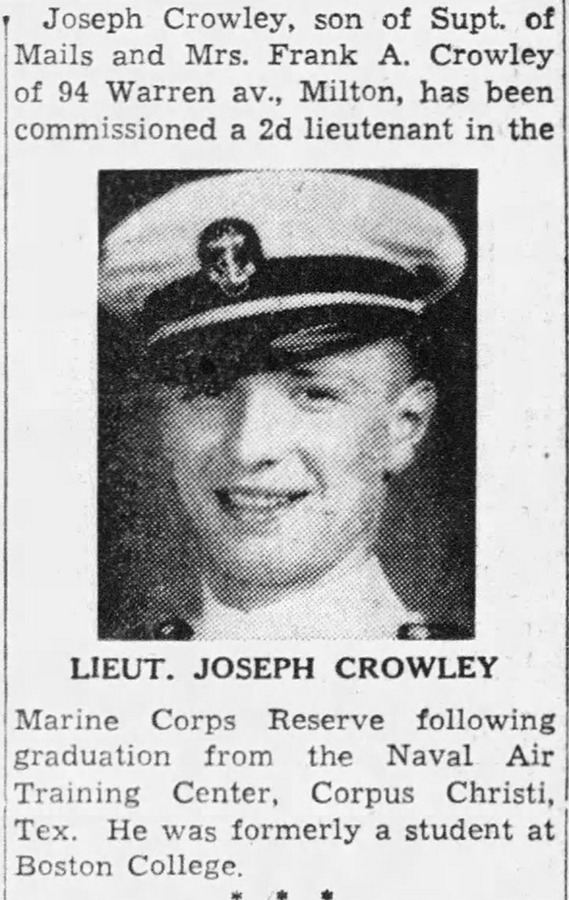
October 20, 1943 (officer)
Home Of Record
94 Warren Avenue
Milton, MA
Next Of Kin
Parents, Frank & Lydia Crowley
Military Specialty
Pilot, torpedo bomber
Individual Decorations
Purple Heart
Loss And Burial
Circumstances Of Loss
Joseph Crowley entered the Navy in August 1942, intending to become a pilot. He received his wings and a Marine Corps commission at NATC Corpus Christi in October 1943, and after additional training at MCAS El Toro, deployed overseas in January 1945 to join veteran squadron VMTB-232 at Ulithi. Crowley piloted an Avenger torpedo bomber (TBM-3 #68526), with PFC Edgar R. Norcross manning the radio and PFC Kenneth D. Gillespie in the gun turret.
By March 1945, Yap was cut off from reinforcements and bombed to ruins – a place of little strategic importance, but useful for green pilots to get combat experience. Yap Airstrip, already pitted by bomb craters, was still vaguely operational and a frequent target for VMSB-232. The squadron flew several uneventful missions, and some wondered if the Japanese were even still there.
The question was answered on 16 March 1945.

Crowley’s plane had just entered its bombing run when its left wing disintegrated, flipping the big bomber on its back. The gunners in another plane watched the stricken Avenger “cartwheel and spin” from 6,000 feet to the ground beside the northeast corner of the airstrip, where it exploded. No parachutes were seen.
Crowley, Norcross, and Gillespie were optimistically reported as “missing in action” after the strike. However, the weight of evidence indicated that all three had perished in the crash. On 11 May 1945, the entire crew was declared dead. They were the squadron’s first combat losses of the 1945 tour, and the only ones killed on a Yap strike.
Joseph Crowley was posthumously promoted to the rank of First Lieutenant.
Burial Information or Disposition
The wreck of Crowley’s aircraft was found by American forces occupying Yap, along with a grave marker inscribed in Japanese: “To the memory of American pilots who died at the front.” Remains were recovered from the site and reburied in a small military cemetery on the island.
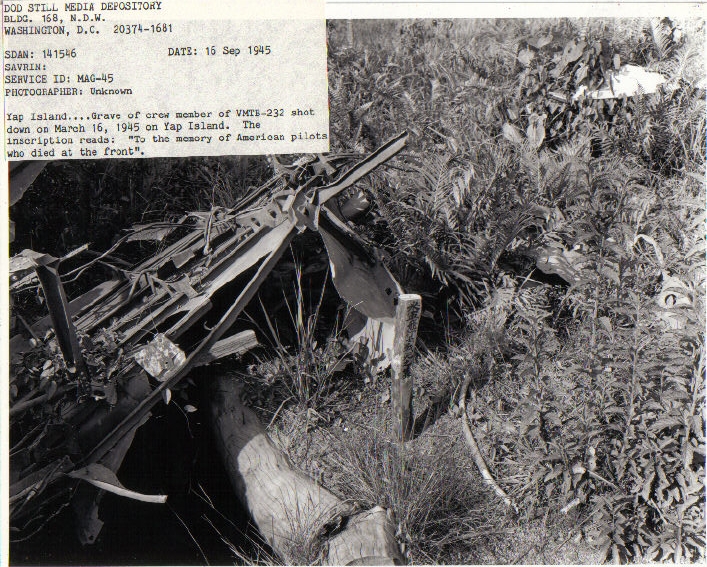
In February 1947, the Yap graves were exhumed and sent to Manila for laboratory analysis. A panel plate reading “BUAERNO 68526” – Crowley’s TBF – was found with remains in Grave #7, and a dental comparison identified the remains of PFC Gillespie. He was returned to his family and buried in Sugar Creek Cemetery, Moberly, Missouri.
However, Grave #7 was a double burial. It seemed logical that the other bones belonged to Crowley or Norcross – or possibly both – and the laboratory mentioned this theory. Unfortunately, the condition of the remains prevented any attempts at individual identification. “Manila Mausoleum X-398” was declared unidentifiable, and the two missing Marines were “approved non-recoverable” in 1949.
On 8 August 2025, the DPAA announced the identification of PFC Edgar R. Norcross as of 12 June 2025.
First Lieutenant Joseph Crowley is still unaccounted for.
Visit Missing Air Crew for more information about TBM-3 #68526.
Memorials
Next Of Kin Address
Address of parents, Frank & Lydia Crowley
Location Of Loss
The Crowley plane crashed beside Yap Airstrip, now part of Yap International Airport.