William John Cusack
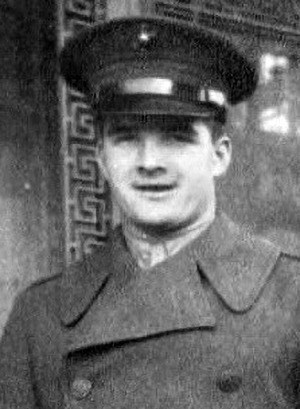
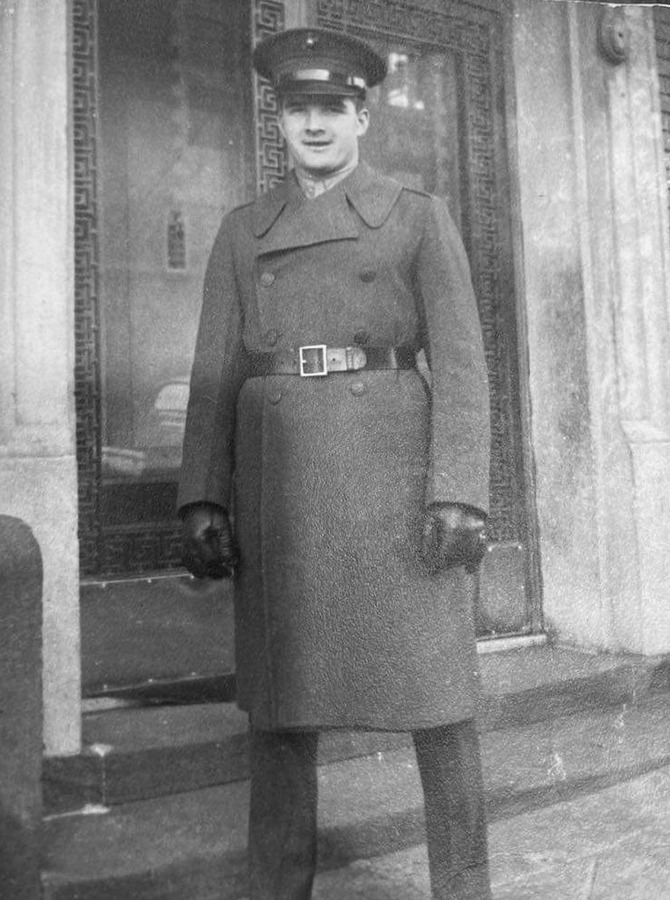
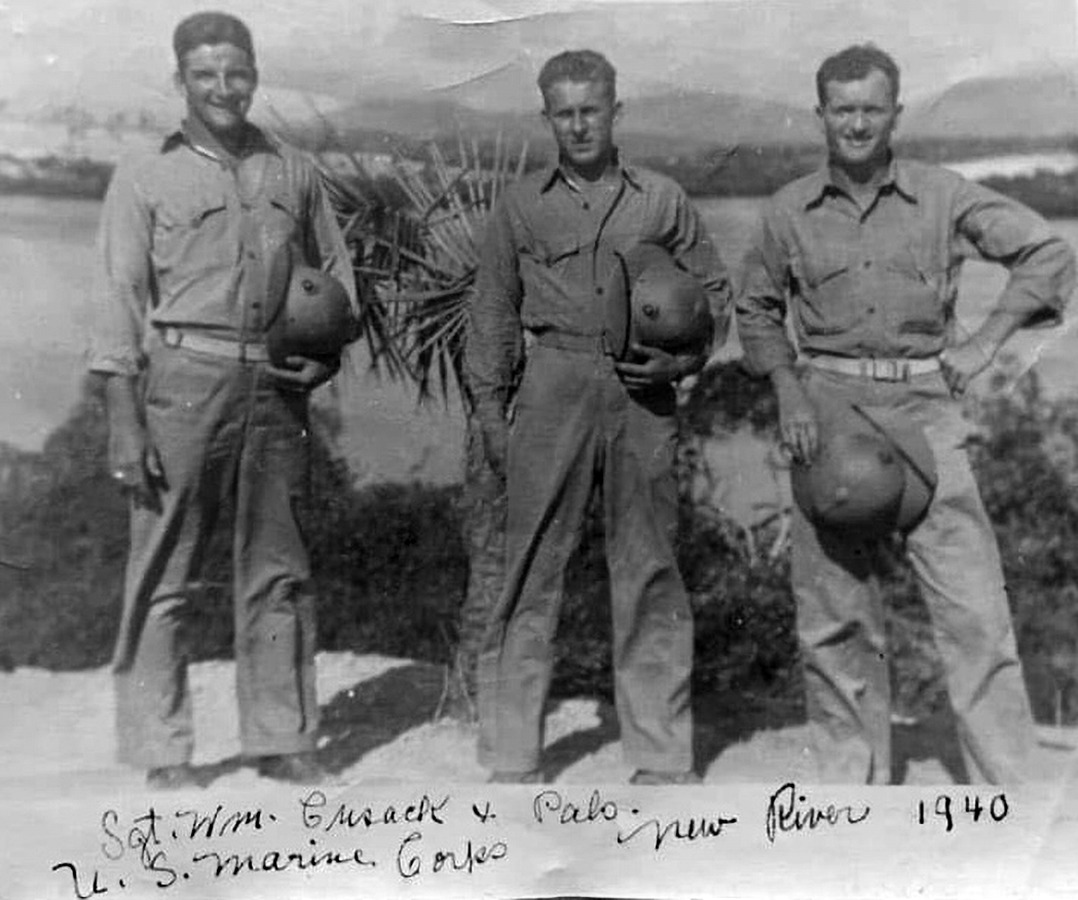
Sergeant William J. Cusack served with George Company, Second Battalion, 7th Marines.
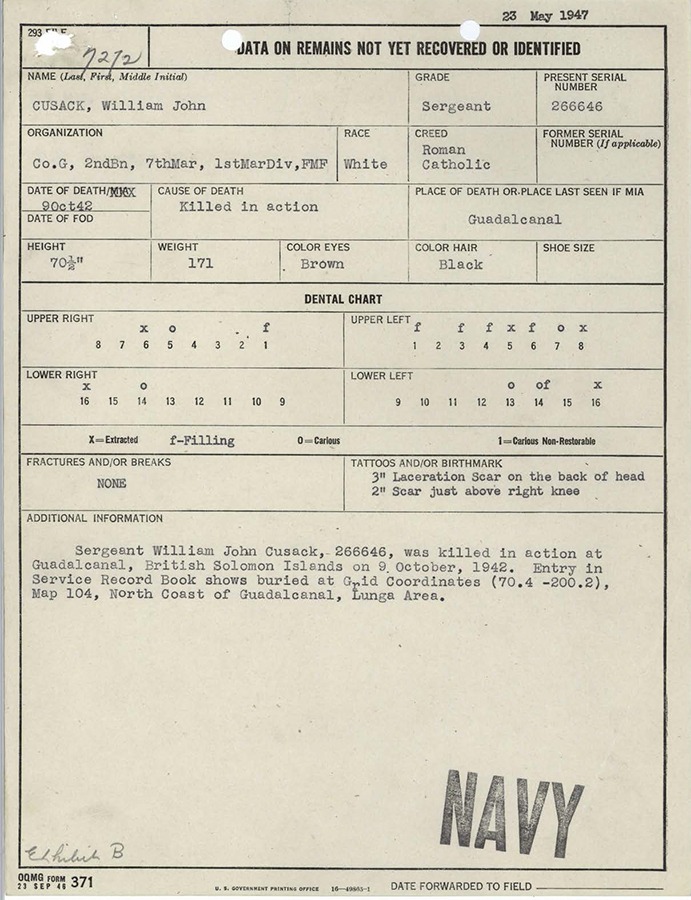
He was killed in action at Guadalcanal, Solomon Islands, on 9 October 1942.
Branch
Marine Corps Reserve
Service Number 266646
Current Status
Remains Not Recovered
Pursuit Category
This case is under Active Pursuit by the DPAA.
Capsule History
Pre-War Life
Birth
November 1, 1918
in Brooklyn, NY
Parents
Helen (Frost) Cusack
separated from
Warren Joseph Cusack
Education
Details unknown
Occupation & Employer
Professional Marine
Service Life
Entered Service
June 13, 1938
at New York, NY
Home Of Record
261 Corbin Place
Brooklyn, NY
Next Of Kin
Mother, Mrs. Helen Cusack
Military Specialty
—
Individual Decorations
Purple Heart
Loss And Burial
Circumstances Of Loss
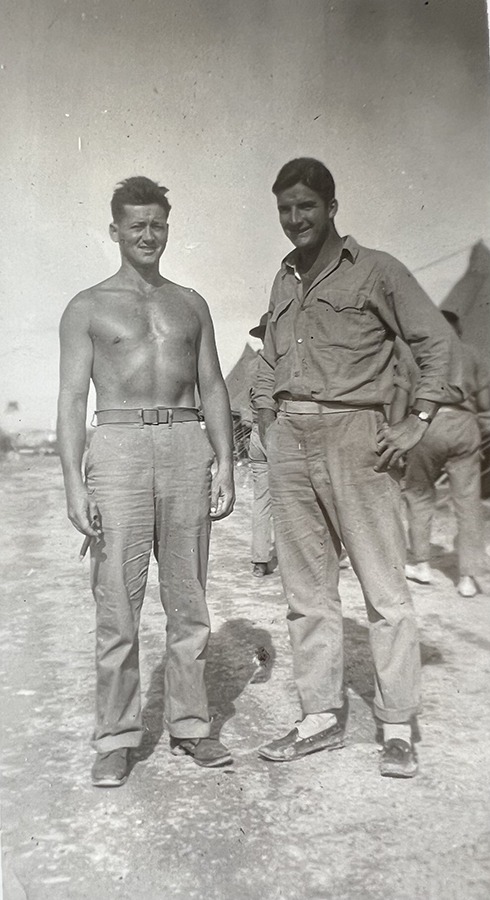
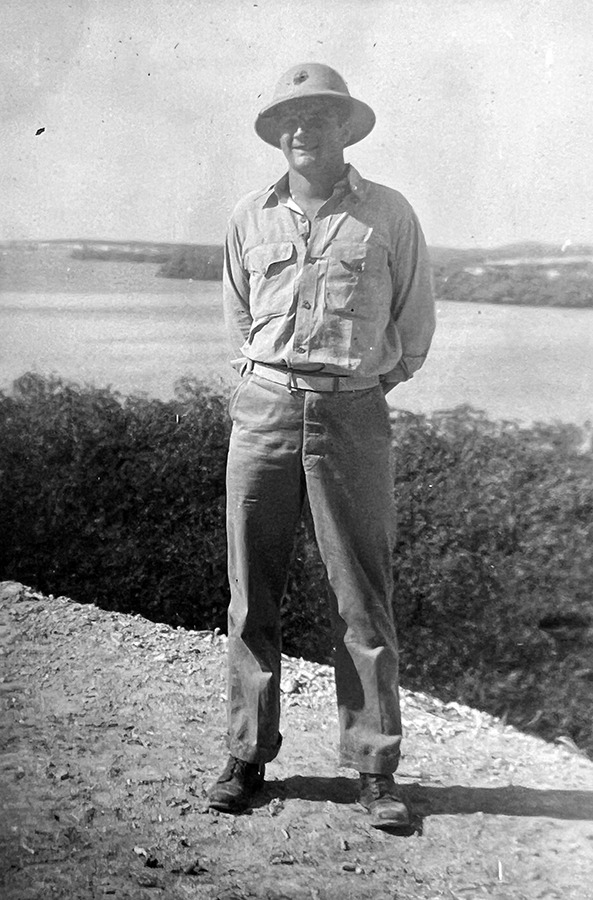
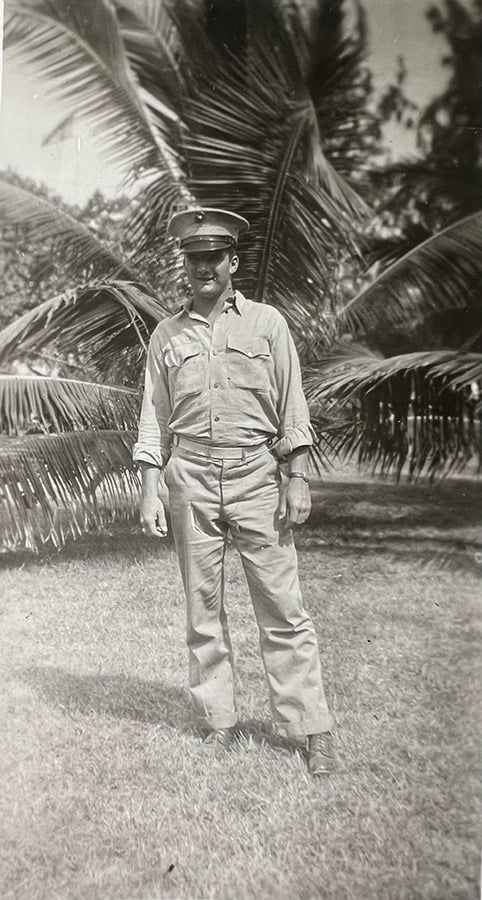
William Cusack enlisted in the Marine Corps Reserves in June 1938, shortly after his twentieth birthday. He trained with the First Battalion, based out of an armory on 52nd Street in his native Brooklyn, and befriended a fellow private named Walter Dunn. In January 1941, the outfit deployed to Guantanamo Bay, Cuba, and was almost immediately disbanded, with its members parceled out to established infantry regiments. Cusack and Dunn were among those assigned to George Company, Second Battalion, 7th Marines.
Dunn kept a diary of the drudgery of daily duty as a Marine Corps private: “life is miserable” with weeks aboard a “lazy, cramped, stinking, pig-iron bastard” of a transport; while other units practice amphibious landings, his company spends days loading and unloading ships with a “strong back – no brains.” Fortunately, his buddy Cusack drew the same duties, which cemented their friendship even after Dunn transferred to Easy Company.
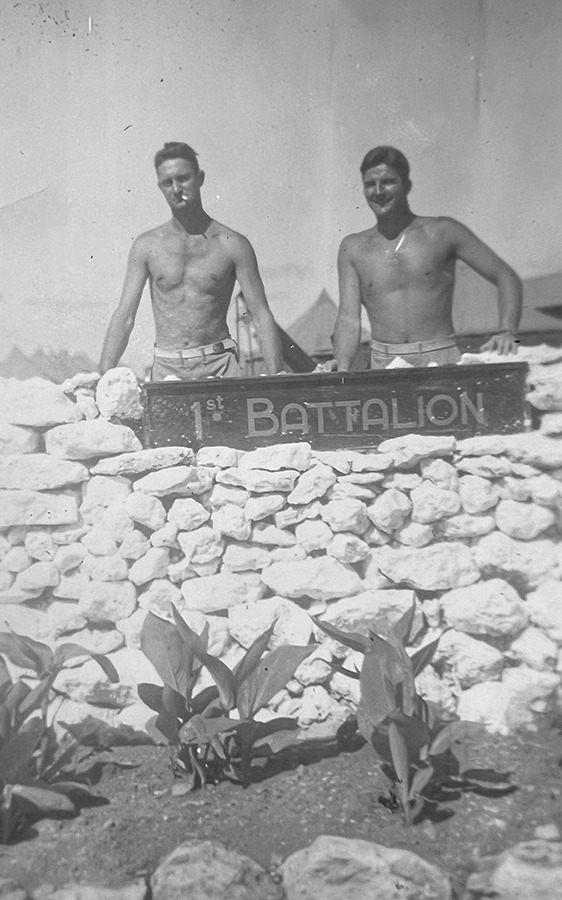
Soon, even these modest diversions were only pleasant memories. “War was declared with Japan and we knew we would soon be in it,” Dunn continued. “There followed six weeks of strenuous training + then reorganization + re-equipping.” They arrived in Samoa in early May 1942 and discovered “a tropical heaven. The natives were friendly and immediately took our money. Barely a nite went by that the Samoan girls didn’t siva [dance] for us.” The 7th Marines garrisoned Upolu until August 1942; when word arrived that the Marine Corps had landed on Guadalcanal, they rightly guessed their time in paradise was growing short. Walter Dunn described a legendary farewell feast with “much singing & loving going on. We all get drunk and have a swell time…. There are sad hearts both on shore and ship.”
Cusack, Dunn, and the rest of their regiment disembarked at Guadalcanal on 18 September 1942. Their first few hours at “Cactus” were not encouraging: accosted by “savage, tired, hungry” Marines telling “weird stories of their battles”; watching an American dive bomber shot down by their transports (killing Second Lieutenant Leland E. Thomas); and a nighttime shelling by the Japanese navy. Combat patrols began two days later, and for a time, the inexperienced Marines were more dangerous to each other than to the enemy: Dunn records one man wounded, and another killed – “our first death in the company” – as the result of friendly fire.
By early October, the 7th Marines had acclimated somewhat and were “raring to go” in pursuit of the enemy. Carrying only their weapons, light packs, and some canned rations, they departed from the Lunga perimeter and marched west towards the Matanikau River. October 7 was “a miserable nite” of cold, constant rain; October 8 little better. “The going is very tough, the trail slippery,” Dunn wrote. “The men tire & complain about the extra load [of ammunition].” Dunn lost his temper at one of his men, and was glad of a short break at the top of a steep hill. Sitting on his ammo box, cold and soaked, Dunn spotted his buddy from Brooklyn, still serving with George Company. “Cusack comes down trail + we talk a little + have a laugh.” They moved out again in slightly better spirits.
The Second Battalion, 7th Marines began 9 October 1942 in a bivouac atop a ridge west of Guadalcanal’s Matanikau River, still soaked and tired from the previous day’s hard march. Early in the morning, Fox Company surprised and wiped out a group of Japanese machine gunners preparing an ambush – but the Japanese returned the favor at 0800 hours, raking Easy Company with concentrated fire and inflicting heavy casualties. A three-hour firefight ensued, as graphically described by Walter Dunn.
George Company, the reserve unit, was instructed to secure Easy Company’s sector, treat the wounded, and bury the dead. Upon receiving orders to return to the Lunga Perimeter, Lt. Col. Herman Hanneken ordered Easy and Fox to wrap up the assault phase, while George would “proceed to the beach with the wounded of this battalion, and three from the First Battalion.” The casualty evacuation mission was by no means easy, and George Company wound up fighting its way back. Six Marines were wounded, and four – including Sergeant William Cusack – were killed on the route back to Lunga.
I get word that Cusack has been hit. An hour later a Marine tells me he was buried in a hole atop the hill. I sit down and finally realize how tired I am. Trucks take us back to our camp area.
Sleep is hard.


Burial Information or Disposition
Encumbered as they were with numerous stretcher cases, George Company could only evacuate one of their KIAs – PFC John W. Louder. Sergeant Cusack and PFCs James M. Lawson, Jr., and Gerald J. McGettrick were buried in the field in two separate locations approximately fifty yards apart.
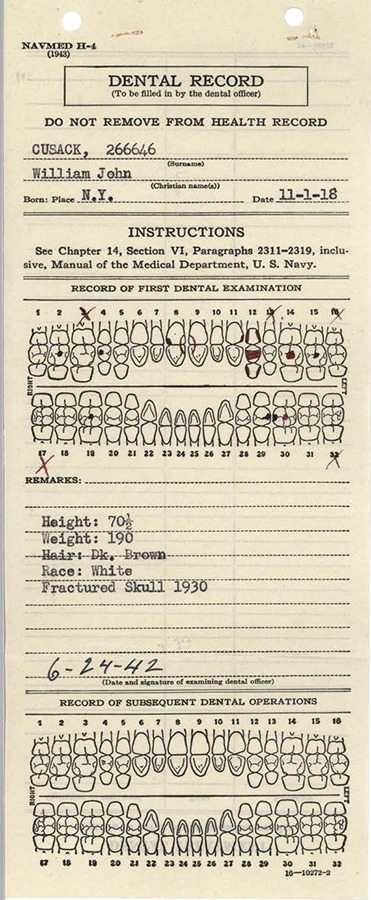
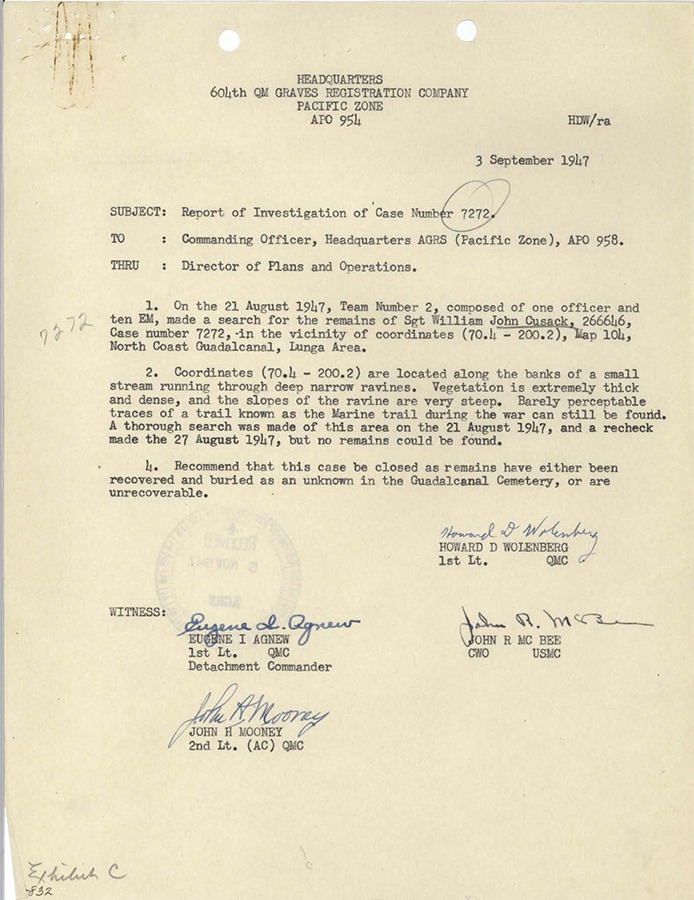
A post-war search by Army Graves Registration troops located Lawson and McGettrick in 1947; their remains were identified and returned to their families for burial. Although the same troops searched for Sergeant Cusack, they were unable to find any recognizable trace of his grave, and he is still on the list of unaccounted-for Marines.
The eight Marines from Dunn’s platoon were also missed by the post-war Graves Registration search. A chance discovery in 1970 led to the identification and repatriation of Corporals Edwin M. Langley and John F. Suggs; Privates First Class Godfrey E. Hunter, Jr., Alba W. Jenkins, David W. Johns, and Rollen Mullins; and Privates Paul E. Gagnon and Eugene Johnston.
Memorials
Special thanks to Linda Plona McMillan, and the family of Sergeant Walter L. Dunn, USMC,
for providing the personal photographs and diary entries used in this article.
Next Of Kin Address
Address of mother, Mrs. Helen G. Cusack.
Location Of Loss
Sergeant Cusack was killed in the vicinity of modern-day Vavea Ridge.

Please let me know if his remains are ever recovered. He was my mother’s first cousin (his mother and my maternal grandmother were sisters). Thank you very much.
I would like to know if his remains were are ever recovered. He was my great uncle. My grandmother’s brother. My father provided DNA and has since passed away.
I would like to know if his remains are ever recovered. He was my great uncle. My grandmother’s brother. My father provided DNA and has since passed away. My great grandmother (Helen) was his mother.
My grandfather, Walter Dunn was William’s friend from Brooklyn. They went through training together and served in 2nd/7th marines. My grandfather was in E company and mentions Cusack multiple times in his journal. He died when I was 4 so I didn’t get to speak with him about the war. But from reading his war journal he really liked Cusack and was devastated when he was killed.
Tom-thank you for your kind words. My grandmother was his sister. She never got over losing her only brother.
Victoria, there aren’t many details about Cusack in my grandfather’s war journal but he does talk about him on 4 or 5 pages. The day before he was killed, my grandfather mentions that Cusack came down the trail to find him and they had a talk and a laugh. He mentions that he was killed on the 9th and that he finally realized how tired he really was. And even though he was finally relieved to be back behind his own lines he couldn’t sleep thinking of the loss of his friend, Cusack. I wanted to reach out to let you know that if my grandfather’s journal is any indication, Cusack was well liked by the men he served with. If you’d like to see copies of his journal where he mentions him, feel free to email me at flywithtommy@gmail.com